Introduction
In this essay I discuss two recent Nintendo DS games, Scribblenauts (2009) and The World Ends with
You (2007), as examples of nostalgic fantasies of handwriting. Nostalgia
for handwriting, and more generally for the materiality of older media in general, is
a common trope in contemporary discussions of medial change. However, such
discussions often understand older media as being more fully material than is in fact
the case. When this assumption is not challenged, it leads to attempts to recapture
the materiality of older media using the tools of new media — attempts which
inevitably fail, as my discussion of Scribblenauts will
show. On the other hand, in my discussion of The World Ends with
You, we will see that nostalgia for the materiality of older media can
also be mobilized productively: such nostalgia can prompt a critical examination of
the question of why materiality is desired in the first place.
Materiality has emerged as a key issue in many recent discussions of digital media
and its relation to older media.
[1]
While materiality is a notoriously slippery concept, for the present purposes I will
define it, adapting Johanna Drucker, as the physical, embodied substrate of a sign —
as those aspects of a sign which are excessive to its signifying value. For Drucker,
any sign involves “two major intertwined strands: that of
a relational, insubstantial, and nontranscendent difference and that of a
phenomenological, apprehendable, immanent substance”
[
Drucker 1997, 43]. For example, any given instance of a printed letter Q can be understood
either from the viewpoint of its semantic value or from that of its material aspects,
such as its typographic properties, the type of ink used to print it, and the
material substrate on which it is printed. These latter features are surplus to the
signifying value of the letter — a Q is still understood as the “same” letter
when any or all of the above-named features are altered, within certain limits — but
they connect the letter to the cultural context from which it emerges.
The introduction of digital technology inaugurates a crisis for traditional models of
materiality. In pre-digital media, the connection between material and signifying
aspects of a sign is unbreakable; any printed, painted, or handwritten sign is
literally inseparable from its physical support and its material properties. Digital
technology is often understood, however, as introducing a gap between these
properties of the sign, such as by separating what Matthew Kirschenbaum calls
formal materiality (briefly, what a sign looks like) from forensic
materiality (what it actually consists of) [
Kirschenbaum 2008, 9–10]. Digital technologies like virtual reality and video games are therefore often
criticized as disembodying the sign or as unmooring it from its materiality. Casey
Alt, for example, notes that “Virtual Reality has signified for most
critics a superficial doubling of surface reality that privileges visuality in
such a way as to more strongly foster an eye-mind link that has little, if
anything, to do with the particular materialities of human embodiment”
[
Alt 2002, 387], although he goes on to significantly complicate this claim.
At stake in such polemics over materiality is the question of what happens to the
embodied self when changes occur in the technological tools whereby
that self communicates itself to the world. Older media technologies — photographic
film and movable type, for example — may be understood (at least naïvely) as being
embodied in the same way that human beings are, as having something “to do with the particular materialities of human
embodiment.” By virtue of their embodied nature, analog and mechanical
technologies seem to osmotically absorb the idiosyncratic properties of the embodied
self that uses them. The supplantation of such technologies by digital technologies
may thus be understood as a supplantation of the embodied self. The link between
embodiment and selfhood is especially strong in the case of the mechanical writing
technology I will discuss here, viz. handwriting, and the fate
of handwriting may be seen as an index of the fate of selfhood in the digital
era.
Fantasies of Handwriting
Handwriting, by definition, is evidence of the presence of the writer's body at the
place and time of writing.
[2] Moreover, handwriting necessarily involves a certain
excessive component not reducible to its signifying value. The shape,
line weight, and other graphic properties of a given handwritten letter are
necessarily present, but are not required in order to differentiate the letter from
other letters; that is, all these properties could change, at least within a certain
limited range, and the letter would be recognizable as the “same” letter. The
excessive aspects of handwriting are an index of the physical and gestural activity
of the hand that produced the letter. Because handwriting reveals both the fact of
the writer's prior bodily presence and the idiosyncratic qualities of the writer's
gestural movements, it is often understood in a more general sense as graphically
embodying the writer's personality or self. For example, the nineteenth-century
pseudoscience of graphology held that a person's character could be read from the
graphic properties of his or her handwriting. Indeed, because this theory presupposes
that people
have a unique and unchangeable personality, it appealed to
nineteenth-century Americans who were faced with the loss of other traditional
grounds for subjectivity [
Thornton 1996, 109 and passim].
Similarly, the Belgian comics scholar Philippe Marion uses psychoanalytic theory to
argue that lettering is a privileged sign of the unique enunciative entity
responsible for a comics text [
Marion 1993]. Such theories of
handwriting hold that in writing by hand, one creates an inscription which functions
simultaneously as a trace of one's bodily presence and as a physical object that
exists independently of oneself. According to these theories, in writing by hand, one
literally
writes oneself into the world.
This, however, represents not a factual account of handwriting but what I would call
a
fantasy of handwriting, because the assignment of positive
connotations of personality and subjectivity to handwriting is a modern invention
which becomes imaginable only after the confrontation of handwriting with alternative
writing systems. When handwriting was the only writing technology available to
individuals, it was often an index of conformity, not individuality. In
eighteenth-century England and America, handwriting was one of several arts devoted
to “the faithful representation of one's
place in society”
[
Thornton 1996, 35]. In Victorian America, handwriting was a means of revealing character, but in
the sense of moral uprightness, not idiosyncratic uniqueness. Sloppy handwriting
might have connoted dishonesty and lack of character rather than positive
unconventionality [
Thornton 1996, 52]. Handwriting historically
often served to mechanize the body rather than liberating its kinesthetic potential;
for example, the purpose of the Palmerian practice of handwriting pedagogy was to
“[turn] the handwriter himself into a
machine” capable of competing with assembly-line technology [
Thornton 1996, 177]; (see also [
Thornton 1996, 21–61 passim]).
The modern understanding of handwriting as expressive of the writer's unique
character is therefore largely attributable to the encounter of handwriting with —
and replacement of handwriting by — print and type. Handwriting takes on connotations
of uniqueness, personality and embodiment precisely because of its contrast with
newer technologies that appear to lack these connotations. For example: “The introduction of the typewriter, for
instance, shifted the emphasis to the standardization of script, but it may
even have increased the notion of authenticity associated with
handwriting”
[
Neef et al. 2006, 8]. The Arts and Crafts calligraphy revival, which emphasized “the characteristics which distinguish
one person's hand from another's ”
qtd. in [
Johnston 1939, 180–181]
and sought “to affirm the value of human
individuality”
[
Thornton 1996, 181], explicitly critiqued the mechanization of handwriting by printed copybooks.
At stake in fantasies of handwriting, then, is a certain traditional concept of the
self as uniquely embodied, as irreducibly bound to its material instantiation. The
fantasy of handwriting develops as an attempt to defend this concept of the self
against technologies that seem to replace the material, bodily self with a mechanical
or digital surrogate.
However, if fantasies of handwriting do no more than lament the loss of the fully
embodied self, they risk becoming purely nostalgic in the restorative sense.
[3] In order to be productive, fantasies of handwriting
need to acknowledge that handwriting, and the self it connotes — a self characterized
by individuality, subjectivity and embodiment — is
always already a lost
object. Its embodied and individualizing aspects come to prominence only
when threatened by mechanical technology. In the absence of such threats, these
aspects of handwriting often fell below the threshold of attention. Analogously, the
typewriter might initially have seemed like an ominous symbol of the mechanization
and disembodiment of writing, but when compared to the word processor, the typewriter
may become nostalgically reenvisioned as an embodied mechanism. (As Arthur Conan
Doyle observed, because each typewriter has a unique pattern of deterioration,
typewritten text can be as idiosyncratic as handwriting (qtd. in [
Gitelman 1999, 215]).
Fantasies of handwriting are created only in retrospect, as a product of the same
process of technological change that renders handwriting obsolete. Therefore, these
fantasies are based on a revisionary, imagined version of handwriting, which is not
necessarily functionally identical to “originary” handwriting (i.e. handwriting
as it existed before typewriting or word processing). As Svetlana Boym argues,
The object of nostalgia is further away than it appears. Nostalgia
is never literal, but lateral. It looks sideways. It is dangerous to take it at
face value. Nostalgic reconstruction is based on mimicry; the past is remade in
the image of a present or a desired future, collective designs are made to
resemble personal aspirations or vice versa.
[Boym 2002, 354]
If the introduction of digital media results in nostalgia for earlier writing
technologies, then this nostalgia refers to objects that never truly existed and are
constructed only retroactively. The values for which handwriting is cherished were
not necessarily present or noticeable before handwriting had anything to be compared
to. Therefore, nostalgia for handwriting is deeply ambivalent: it wishes to return to
an original condition of handwriting, but knows such a return is already impossible
as soon as the need for it is felt.
[4] Moreover, because fantasies of
handwriting arise only after handwriting becomes practically obsolete, they are
typically promulgated using the same technologies that they critique.
[5] In order to be honest rather than purely
ludditical or atavistic — in order to be reflective rather than restorative, in
Boym's terminology — fantasies of handwriting need to acknowledge the profound gap
between originary and reenvisioned handwriting.
For example, Sven Birkerts, a notable opponent of digital technology, observed in
1996 that word processing destroys the commitment to truth that characterized
handwriting and typewriting. Because correcting errors on a word processor is a
trivial task, the writer no longer needs to think carefully before writing [
Birkerts 2006, 157]. This claim is a classic piece of revisionary
nostalgia. It advocates a simple return to the past, ignoring the fact that such a
return is no longer possible, and not least because the past is only constructed in
light of the present. Until Birkerts used a writing technology that enabled him to
correct errors effortlessly, he presumably didn't realize that difficulty in
correcting errors was beneficial. In a text written ten years later, Birkerts admits
that he has been forced to accept the use of digital technology. Though he still
writes his first drafts in longhand, he now e-mails them to his editor, and his house
is full of technological gadgets, including a PlayStation [
Birkerts 2006, 231–232]. As a reluctant convert to digital technology, he feels “like a man living in exile [...]
operating provisionally, skeptically, not letting himself form deeper ties
because he believes he will one day be returning home”
[
Birkerts 2006, 234]. Yet Birkerts admits that this belief is not a sincere one, that he knows he
can't return from the Babylonian captivity of computers to the Zion of manual
writing. Birkerts's revised argument is an example of a reflective fantasy of
handwriting, which acknowledges that to remember handwriting is also to retroactively
construct it. Here the fantasy of handwriting becomes not merely a lament for the
loss of the handwritten self, but a meditation on the conditions of possibility of
that self.
Handwriting in Video Games
Contemporary video games represent an important site of both restorative and
reflective fantasies of handwriting. It seems counterintuitive that a digital
technology could operate as a means of remediating and recollecting a manual one. Yet
as alluded to above, fantasies of handwriting arise only due to the replacement of
handwriting by more efficient technologies. It's therefore perhaps inevitable that
these fantasies should be communicated by means of those technologies.
Handwriting, typing and mental writing had a surprising degree of importance at the
origins of video gaming, and their widespread replacement by graphics produces a
sense of nostalgia for these modes of interaction. Nick Montfort reminds us that “early interaction with computers
happened largely on paper: on paper tape, on punchcards, and on print terminals
and teletypewriters, with their scroll-like supplies of continuous paper for
printing output and input both”
[
Montfort 2004, n.p.]. For example, Will Crowther wrote
Adventure
(1975), the first text adventure game, on an ASR-33 Teletype, an interface that
preserved the embodied properties of the typewriter, and he may have corrected his
code in pen or pencil [
Montfort 2004, n.p.].
[6] The
game was created in tandem with a hand-drawn map of part of Kentucky's Mammoth Cave,
which was based on computational line plots of data gathered by Crowther and other
cavers with compasses and measuring tapes [
Jerz 2007, ¶59]. At the
origin of
Adventure, and thus of a certain tradition of
narrative video gaming, are various processes of embodied writing. Playing text
adventures equally involves real or metaphorical writing. The text adventure game
involves the exploration of a simulated world which is not visually depicted, so to
navigate that space effectively, the player must develop a functional understanding
of its geography and the contents of each of its locations. One way to do this is to
imagine what the gameworld looks like. This process is comparable to writing or
drawing because it involves the creation of a visual artifact (imaginary in one case,
real in the other) which didn't exist before and which is to some extent unique to
oneself.
[7] Another way to understand
the gameworld visually was to map it on paper. Accordingly, hand-drawn and
hand-annotated paper maps were an invaluable accessory to early Adventure players
[
Montfort 2004, n.p.].
Even after graphics became the norm in video games, scriptural processes continued to
characterize their creation and reception in various ways. Ken and Roberta Williams's
Mystery House, the earliest graphical adventure game,
featured vector graphics rendered with a light pen, some of which were
representations of handwriting [
Kirschenbaum 2008, 131–132].
Mapping the gameworld on paper was still often necessary even when the gameworld was
visually rendered. For example, in
Wizardry (1981), the
dungeons were designed so as to be mappable on graph paper and the manual emphasized
the importance of mapping [
Barton 2008, 71]. Players of such games
also used paper in order to keep track of other relevant information not tracked
automatically by the game. Players of games like
Wizardry and
Ultima (1980) were heavily
reliant on paper “notes, records and ledgers of their
individual game experiences”
[
Myers 2003, 17]. In this respect these games mimicked the non-electronic genre from which they
were descended: the “paper-and-pencil” RPG [
Myers 2003, 16], whose very name comes from the fact that it employs
handwriting as a system of record-keeping.
Over the course of video game history, the embodied and scriptural modes of
interaction characteristic of early video gaming were shunted aside by other modes of
interaction which claimed to offer greater transparency or immersivity.
[8]
After ADVENT
[i.e. Adventure], the adventure genre moved
through several superficially distinct forms: the original text adventures;
graphic adventures (e.g., Myst); and third-person
graphic adventures (e.g., King's Quest). The
differences among these were the result of differences among game signifiers;
each employed the same basic signification process.
[Myers 2003, 15]
These latter genres were functionally identical to the text adventure in terms
of gameplay, but their more transparent graphical interfaces decreased the player's
ability to inscribe himself or herself into the gameworld. The increasing visual
richness of the gameworld deprives the player of the need or desire to imagine it. A
game like
Myst, for example, offers the player little if
any opportunity to inscribe anything into the gameworld because that world is already
prerendered in immense detail. (This is ironic, since the premise of
Myst is that one can transport oneself into other worlds by
writing about them, and the infradiegetic texts in the game are
handwritten.) Figuratively, as graphics become more transparent, the condition of
possibility of inscription on the player's part — the existence of a blank space on
which to write — is lost. An analogous development was the introduction of
automapping in the late 1980s, which eliminated the need to graphically depict the
gameworld on paper.
Mainstream accounts of video game history tend to ignore the loss of the
inscriptional and material aspects of video gaming, or to treat this loss as the
natural consequence of the medium's evolution toward greater transparency. For
example, Julian Dibbell dismissively contrasts
Adventure's “laconic text
descriptions navigated by means of simple two-word commands” with
Myst's point-and-click interface and “complex graphical environments of an
almost liquid radiance”
[
Dibbell 2001]. Dibbell characterizes
Adventure, with its sparse
textual descriptions and its unnatural interface, as the starting point of a
teleological progression that culminates in the radiant visuality and naturalistic
interface of
Myst (and now in stereoscopic 3D graphics
and controllerless interfaces like Microsoft's Kinect). In presenting transparency as
the teleological goal of video gaming, such accounts seek to draw attention away from
the possibilities of embodied inscription that are foreclosed by transparency,
following what Terry Harpold calls the discourse of the upgrade path:
Because technical innovation in popular
computing is driven more by the allure of expanding markets than by something
so quaint as a sense of responsibility to historical continuity, commercial
discourses of the upgrade path will inevitably promise consumers new and more
satisfying interactions, and encourage them to see the older ones as outmoded
or no longer relevant.
[Harpold 2009, 3]
Yet the disappearance of handwriting also inspires nostalgia for and fantasies
of handwriting. Within the video game industry, this began to occur as early as 1983
when Infocom, the preeminent developer of text adventure games, released ads that
claimed:
We draw
our graphics from the limitless imagery of your imagination — a technology so
powerful, it makes any picture that's ever come out of a screen look like graffiti
by comparison […] And you're immersed in rich environments alive with
personalities as real as any you'll meet in the flesh — yet all the more vivid
because they're perceived directly by your mind's eye, not through your external
senses.[9]
This claim follows the logic of transparency [
Bolter & Grusin 2003, 21–24] in that it characterizes text as
more visually rich and
immersive than graphics, since the power of imaginative visualization is not subject
to the limits of current graphical technology. Accordingly, other ads from this
campaign criticize the quality of contemporaneous computer graphics.
Yet the ad also implies that text has advantages over graphics regardless of
graphics' present state of technological evolution: it begins by claiming “there's never been a computer made by man that could
handle the images we produce. And there never will be.” Whatever their
quality, graphics are limited by technological constraints, whereas mental images are
limited only by the player's imaginative capacity and existing repertory of visual
experience. (Perhaps deliberately, the Infocom ad fails to acknowledge that these are
hardly insignificant limits, or that players might differ in their ability or
inclination to visualize.) Moreover, imaginative visualization of the gameworld is an
embodied process situated in the player's brain: the ad campaign describes the brain
as “the world's most powerful graphics
technology.” Visualization varies according to the preferences of each
individual player, and is thus as personal as handwriting, whereas graphics look the
same to everyone. In stressing the value of text over graphics, Infocom nostalgically
advocated the personalized aspects of older technology against the allegedly superior
transparency of newer technology.
This sort of nostalgia was more restorative than reflective, as it merely argued that
the old technology was better than the new one. Such restorative nostalgia is not
uncommon in the video game industry: “As game technology has improved and as
daily life becomes more saturated with media technology, [...] early video
games have also become objects of nostalgia in that their low-resolution
aesthetics have come to be perceived as a retrospective ideal”
[
Whalen & Taylor 2008, 7]. Video game nostalgia becomes reflective rather than restorative when game
creators acknowledge that earlier video games are retroactively altered in the
process of remembering them. Reflective nostalgia can even be aided by the use of the
same new gaming technologies that made the old ones obsolete; the superior
affordances of new video gaming technologies can be used to open up ways of
rethinking and reimagining older gaming genres and technologies. For example, the
Nintendo DS
Retro Game Challenge (Namco Bandai Games,
2007/2009) offers a collection of eight video games that parody or pay homage various
NES games; it takes advantage of the superior storage of DS cartridges. What's
essential, however, is that the nostalgic game not merely repeat the object of
nostalgia; it must also acknowledge the fact that the object of nostalgia is
unrecoverable in its originary form. Similar claims can be made about video games
that incorporate nostalgia for and fantasies of handwriting. In order to be
productive, such games have to take into account the profound gap between handwriting
and the digital technologies used to remediate it, rather than seeking to fully
restore handwriting to its original state.
I will demonstrate this by means of case studies of two games for the Nintendo DS
handheld system — a system which has unusual material features that, I will argue,
make it particularly well adapted to the presentation of fantasies of handwriting.
Thus, by examining DS games that take advantage of these features, we can learn much
about how fantasies of handwriting are transformed by digital technology.
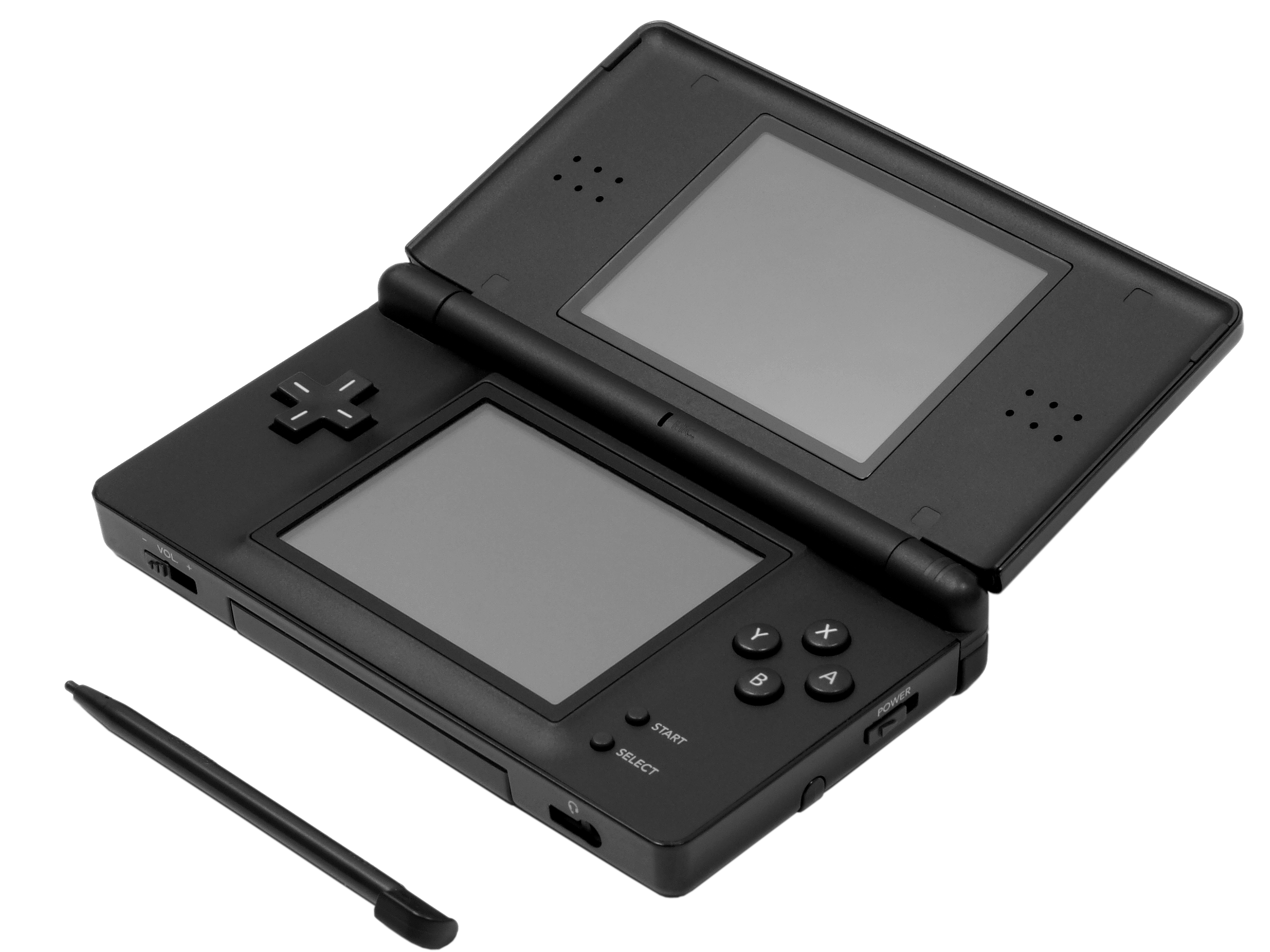
The DS is unique in that it features two screens. The top screen is a conventional
LCD screen, but the bottom screen is overlaid with a resistive touchscreen which
accepts input from a stylus or other pointing device. A resistive touchscreen
consists of two sheets of electrically resistive material with a gap between them.
When the stylus makes contact with the surface of the screen, the two sheets are
compressed together, creating an electrical impulse, and the X and Y coordinates of
the location of the impulse are registered [
Wikipedia 2010a].
Not all DS games require the use of the stylus at all — for example,
Final Fantasy IV (2008) and
Dragon
Quest V (2009) use the stylus only for optional minigames. In some DS
games — e.g.
The Legend of Zelda: Spirit Tracks (2009)
or
Dragon Quest IX (2010) — the stylus is used merely as
a pointing device, and the player uses it only to perform nondiegetic operator acts
or move acts [
Galloway 2006, 12, 22]. In other games, however,
using the stylus represents an expressive act, i.e. an action that “exert[s] an expressive desire outward
from the player character to objects in the world that are deemed
actionable”
[
Galloway 2006, 24]. In DS games, the action expressed by using the stylus is often the act of
using a tool, and the stylus often
represents this tool, in the same
sense in which a theatrical prop sword “represents” a real sword. This is a
crucial difference between the DS stylus and other video game control mechanisms. In
general, players always perform expressive acts by means of some form of material
engagement with the game's control mechanism: “while there is an imaginative form of
the expressive act within the diegesis of the game, there is also a physical
form of the same act”
[
Galloway 2006, 25]. However, with traditional control mechanisms the “physical form” and the
“imaginative form” usually have little in common. The player pushes a button
to make the avatar jump, fire a gun, swing a sword, or do various other acts that are
dissimilar to the act of pushing a button. By contrast, with the DS stylus, the
“physical form” of an expressive act often resembles its “imaginative
form,” because the player uses the stylus — an elongated, hand-held tool — to
simulate an act that is performed using just such a tool. For example, in
Trauma Center: Under the Knife (2005), the player uses the
stylus as a scalpel, simulating the act of making an incision by “cutting” along
a line drawn on a patient's body. In
Grand Theft Auto: Chinatown
Wars (2009), the player hotwires a car by using the stylus to unscrew the
ignition switch. The player draws a circle on the screen, simulating the act of
turning a screwdriver.
Other contemporary gaming systems — the Nintendo Wii, the Sony Move, the Microsoft
Kinect — make similar use of analog control mechanisms in order to erase the gap
between the physical and the imaginative form of the expressive act. For example, in
Kinect Sports (2010), the player plays table tennis
using his or her hand as a paddle, or throws a javelin by making the appropriate arm
motion. However, the DS differs from these three platforms in that it requires
physical contact with a two-dimensional control surface. Using the Wii, Kinect or
Move entails making gestures in the air, whether with a control device or without.
Using the DS entails making inscriptions on a surface. This makes the DS uniquely
appropriate for the simulation of physical acts that involve engagement between a
hand-held tool and a flat surface — and the principal example of such an act is
writing. The DS is thus particularly well suited to the simulation of
handwriting and the promulgation of fantasies of handwriting, and the two games I
will analyze in depth both employ the DS for this purpose. Again, these games can be
differentiated from games on other platforms that employ interfaces that mimic
handwriting. Perhaps the most notable example of such a game is Ōkami (Clover Studio, 2006), a PlayStation 2 game, later ported to the
Wii, in which the player can transform the three-dimensionally rendered gameworld in
various ways by writing on it with a “Celestial Brush.”
Ōkami, however, is controlled with an analog thumbstick
(or later the Wiimote) rather than a true handwriting interface, and thus the player
of Ōkami simulates handwriting by performing an act which only loosely resembles the
actual act of handwriting. The difference between the Celestial Brush and a real ink
brush is obvious — much more obvious than the difference between the DS stylus and an
actual pen or pencil.
Using the DS stylus feels like handwriting. This perception is
reinforced by the material qualities of the system itself, which is about the size
and shape of a small paperback volume. Some games (e.g. Hotel
Dusk: Room 215 [2007]) even ask the player to hold the DS sideways, so
that the player feels he or she is holding a small datebook or planner in one hand,
and writing in it with the other. It's because of the close perceptual similarity
between DS writing and handwriting that the DS represents such a crucial test case
for fantasies of handwriting. Does the DS merely create a dishonest simulacrum of
handwriting, or can the DS open up a space for critical reflection on what
handwriting means? My two case studies will address this question.
Scribblenauts
One of the most heavily hyped DS games of 2009, Scribblenauts revolves around a premise which is brilliant in its
simplicity. When the player writes the name of any object, within certain limits,
that object is created. In other words, if the player writes anything from
“scissors” to “sewing machine” to “Cthulhu” (using either an
onscreen keypad or a handwriting interface), that object appears in the gameworld.
The player can then move it around with the stylus, and it can interact with other
objects and with the player character. This simple premise creates the possibility of
an arbitrarily large number of object interactions and puzzle solutions. Scribblenauts's lexicon includes tens of thousands of words,
so any common object the player can think of is quite likely to be included, creating
the impression that the player's freedom of action is limited less by the game's
lexicon than by his or her imagination and vocabulary.
Scribblenauts presents this gaming mechanic as a
remediation of handwriting. To “scribble” is to “write in an irregular, slovenly, or
illegible hand through haste or carelessness; also, to produce (marks, a
drawing, etc.) or portray (an object) by rapid and irregular strokes like those
of hurried writing”
[
OED 1989]. Although “scribbling” may pertain to content as well as penmanship, the
word has strong associations with handwriting. A scribble
naut, then, is
one who writes quickly and playfully, by hand, as a means of exploration — or, by
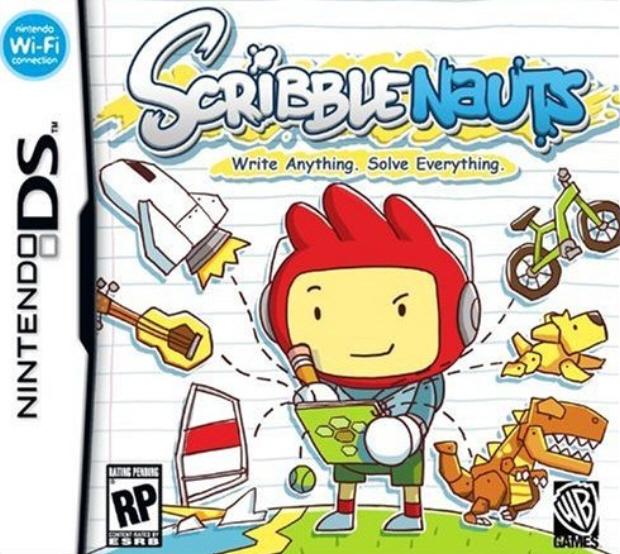
analogy with “astronaut,” one who explores the realm of scribbles. On the game's
cover, we see the avatar, Maxwell, writing with a pencil. The logo looks handwritten
(the two B's look significantly different) and the slogan is set in the Comic Sans
font, which mimics the stereotypical handwriting of comic book letterers. In the
game, the visual motif of wide-ruled notebook paper, which appears on the handwriting
interface screen, alludes to elementary school handwriting exercises.
Scribblenauts thus connects handwriting with childhood, and
thus promises to return the player to an idyllic former state when handwriting
represented a new way of expressing oneself both visually and linguistically. The DS
itself is often denigrated as a system for children, perhaps due to this very
association of handwriting with childhood as well as to its large library of
educational software.
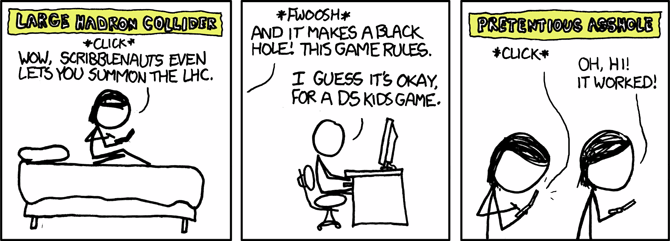
Scribblenauts seems to accept this
characterization and to turn it into something positive, as indicated by one artistic
response to the game [
Munroe 2009]:
Rather than disputing the male stick figure's claim that Scribblenauts is a “DS kid's game”
or his equation of “DS” with “kids,” the female stick figure accuses him of
pretentiousness. The point is that Scribblenauts is a
“kid's game” in a positive sense. It
partakes of the optimism of childhood and reminds the player of the novelty and
empowerment involved in first learning to write. (This is, of course, restorative
nostalgia, as it ignores that the study of handwriting is usually stigmatized in
American culture as tedious busywork, and may only be remembered fondly in
hindsight).
Scribblenauts offers the player something more than
handwriting itself provides, since it turns handwriting into a means of generating
magical effects. However, the suggestion is that the differences between actual
handwriting and the Scribblenauts interface are
differences of degree rather than kind. If Scribblenauts
gives the player the magical power to summon objects into existence (or the same
level of existence enjoyed by the other preexisting objects in the gameworld), then
this is precisely what handwriting does, according to fantasies of handwriting. In
such fantasies, handwriting means writing oneself into the world. The
handwritten word or the hand-drawn line is a material object as well as a sign — as
is whimsically demonstrated in the silent cartoon “Comicalamities” (1928), where Otto Messmer draws Felix the Cat in pen, and
Felix then starts to behave independently and interact with his creator. By writing
with pen and paper, one creates permanent material traces which are as real as the
pen and paper. Thus, in Scribblenauts, when the player
writes “shovel,” a simulated shovel comes into existence and, within the
diegetic world, has at least as much solidity and permanence as the written word
“shovel” would in the real world. The game suggests that this simulated
object does not merely replace, but is instead identical to, its
handwritten name. (By toggling an onscreen icon, the player can tap any object to see
its name. When this is done with a player-created object, the game displays the name
that was used to create that object, even if it has other possible names.) In Scribblenauts, to write by hand is literally to create
objects, and this is presented not as a drastic alteration of the meaning of
handwriting but as an unleashing of a magical potential that was always already
present in handwriting. Of course there is a difficulty here, in that the words the
player actually writes in Scribblenauts are far less
permanent than actual handwriting. When the player writes “shovel,” each letter of
the word vanishes from the screen once written (the game's handwriting interface
allows the player to write only one letter at a time), so the handwritten word never
even exists as a complete entity. However, the creators of Scribblenauts seem to want the player to ignore this difference between
the game's handwriting and originary handwriting.
Scribblenauts further enacts the fantasy of handwriting
by promising that, through using handwriting to create objects, the player can
practice the values of personality and creativity that handwriting represents, by
traversing the game however s/he chooses. The game's slogan, “Write Anything. Solve Everything,” testifies to this promise of
unlimited interactional freedom. On the game's title screen, the player can literally
fulfill the first half of this slogan by writing objects without the risk of dying.
Of course, the title screen is not actually a game in the strict sense, because games
employ “rules and constraints in order to
define and bound the play experience”
[
Tanenbaum & Tanenbaum 2009, 3]. A successful gameplay experience involves a delicate balance between player
agency and authorial control, in which the player expresses agency within the
contours of an authorial framework.
[10] This is analogous to how handwriting, as
fantasized, involves personal improvisation on predefined letterforms. However, the
gamic (i.e. goal-oriented) portion of
Scribblenauts
provides an unusually loose authorial framework, and thus claims to offer the player
broad opportunities to express the same sort of creative agency that handwriting
represents. In each of
Scribblenauts’s 220 levels, the
player's goal is to obtain a McGuffin object called a “Starite,” either by
traversing a series of obstacles to reach the Starite, or by fulfilling a predefined
condition in order to make the Starite appear. The player can use any object or
combination of objects in order to solve each level. Because of the vastness of the
game's lexicon, each level (supposedly) has many possible solutions none of which is
uniquely correct. Therefore, the achievement of solving a level testifies to the
player's ability to think creatively, as opposed to merely reconstructing the
solution the developer had in mind. The game even rewards the player for solving each
puzzle three times without reusing any words. In playing
Scribblenauts, then, the player not only writes objects into existence,
but does so in a creative, idiosyncratic way, so that the objects the player writes
are also testaments to the player's faculty for creative thinking and
improvisation.
In short,
Scribblenauts enacts the fantasy of
handwriting in a highly literal way. The game's massive critical and commercial
success, despite several widely acknowledged flaws, suggests that this strategy of
cultivating nostalgia for handwriting appeals to DS consumers.
[11] However, the
trouble with the fantasy of handwriting is that it is a fantasy — an account of what
we
want handwriting to be, not of what handwriting actually is. The
fantasy of handwriting expresses a
desire to engage in a certain type of
material interaction, yet this desire is predicated on a lack: we only want
handwriting because we don't and can't have it. When games or other texts try to
satisfy the desire for the fantasized version of handwriting, all they can accomplish
is to show the unsatisfiability of that desire.
This, at least, is what happens in
Scribblenauts. This
game can only fulfill its promise to satisfy the desire for handwriting if it
actually enables the player to use handwriting as an interface. However, in actual
game play, the player is discouraged from using the handwriting interface because of
its inefficiency.
Scribblenauts offers two different
interfaces: a handwriting interface in which the player writes one letter at a time,
and an onscreen keypad. Thus:
The original design of Scribblenauts called for writing letters, with the
stylus to serve as the main method of word input — we loved the visceral
feeling of writing and watching an object appear.
[Tringali 2009]
Accordingly, the game's developers, 5th Cell, used the keyboard interface only
as “backup” while designing custom handwriting recognition software. However:
Eventually we realized that no
handwriting recognition software could operate faster than a keyboard. We still
spent time refining the letter recognition, but it was clear keyboard input
would be the primary input method for Scribblenauts.
[Tringali 2009]
Greater speed is the primary affordance of the keyboard interface in
Scribblenauts over the handwriting interface, and indeed, of
typing over handwriting more generally. Despite the best efforts of pedagogues like
Austin Norman Palmer, handwriting can't compete with the mechanical efficiency of
typing. Indeed, this is one major
reason for the contemporary
privileging of handwriting. For Arts and Crafts calligraphy revivalists, handwriting
was valuable because it represented conscious, thoughtful craftsmanship, in contrast
to the soulless efficiency of the machine [
Thornton 1996, 179–181]. This valuation of handwriting as a sign of individual creative labor is closely
allied to
Scribblenauts’s ideological project. Yet as a
fast-paced action game,
Scribblenauts cannot afford the
loss of gameplay speed that handwriting entails, and it gives the player no incentive
to use the handwriting interface rather than the keyboard.
Furthermore, even if the player uses the handwriting interface, this doesn't entail a
complete revival of handwriting, because handwriting recognition technology involves
stripping out the unique and personal aspects of the player's handwriting. According
to two experts in the field, handwriting recognition is defined as “the task of transforming a language
represented in its spatial form of signifying marks into its symbolic
representation”
[
Plamondon & Srihari 2000, 64]. It operates by recording the temporal and spatial parameters of handwritten
traces, preprocessing them to eliminate noise, and then comparing them to a set of
predefined letterforms stored in memory. Its purpose is to extract the semantic value
of a handwritten message, precisely by abstracting out the excessive and
idiosyncratic qualities that make handwriting an object of nostalgia: “[H]andwriting recognition and
interpretation are processes whose objectives are to filter out the variations
so as to determine the message”
[
Plamondon & Srihari 2000, 64].
Scribblenauts, then, can only preserve the
idiosyncrasy of the player's handwriting in a figurative sense, if at all, and not in
a literal sense.
Finally, writing on the DS touchscreen is an extreme abstraction of writing on paper,
because the DS's touchscreen records only the two-dimensional shape of a stroke and
the order and direction in which strokes were made. It ignores, for example, the
pressure with which the stroke is made, a property which other touchscreen
technologies try to preserve. (Wacom graphics tablets, for example, come with a
pressure-sensitive stylus).
[12] Moreover, the touchscreen itself,
unlike paper, is a purely two-dimensional surface; it has only one side and no
thickness. Nor does the touchscreen perserve the visible traces of what's written on
it. When a line is drawn on a touchscreen, it's recorded as stroke data which may be
permanently stored in memory, yet the line itself soon disappears. The DS may
feel more like paper than other video game technologies, yet it is
irreducibly
unlike paper in terms of how it responds to input. In
general, the DS does a much more effective job of remediating handwriting than the
PS2 or the Wii did (in the case of
Ōkami). Even so, the
DS's version of handwriting is quite far from the real thing.
It would obviously be premature to conclude from this that touchscreen technology is
incapable of replicating the “personal” or “embodied” properties of
handwriting — if this is true, it's only true insofar as those properties are only
ever incompletely present in handwriting to begin with. We can, however, conclude
that the DS's handwriting recognition technology is not intended to
preserve the player's subjective traces. The DS's handwriting interface is a
component, not of a dedicated artistic tool like a Wacom tablet, but of a gaming
interface. It therefore has to enable both player agency, which includes
creativity, and efficient interaction — which often operate at cross
purposes, as demonstrated when 5th Cell ceased development on the Scribblenauts handwriting interface. When 5th Cell used the
DS to present an uncritical version of the fantasy of handwriting, they failed to do
so with complete success, because they ignored the gap between DS handwriting and
originary handwriting.
Scribblenauts, then, cannot fully satisfy the desire for
handwriting in a literal sense, nor does it fully succeed in doing so in a figurative
sense by enabling players to exercise the creative agency that handwriting
represents. The game often provides insufficient opportunities to exercise creative
agency. Many of its levels ask the player to repeatedly perform the same tasks, like
killing enemies, flying, swimming or digging through dirt, and only a few words in
the lexicon are capable of accomplishing these tasks efficiently. The need to
repeatedly perform these tasks forces the player to overrely on certain words, which
limits the player's ability to exercise genuine creativity.
[13]
This isn't to say that Scribblenauts can't trigger
reflective nostalgia for handwriting on the part of the player — that it can't make
the player critically evaluate the difference between originary handwriting and the
version of handwriting it offers. Indeed, Scribblenauts
is likely to produce this effect unintentionally, by forcing the player to observe
the incomplete success of its remediation of handwriting. However, it appears that
producing critical reflection on handwriting was not 5th Cell's primary intent in
creating this game; instead, they sought merely to use the DS interface to satisfy
the desire for handwriting. By contrast, The World Ends with
You makes a more sincere effort to encourage critical reflection on
handwriting, because it makes no claim to fully satisfy the desire for handwriting.
In examining this game, therefore, we can get a better idea of what a critical,
digital version of the fantasy of handwriting might look like.
The World Ends with You
Developed by SquareEnix and Jupiter,
The World Ends with
You (TWEWY) was released in Japan in 2007 under the title
Subarashiki kono sekai
(“It's a Wonderful World”), and was released in
America and Europe the following year.
[14] Although it resembles a traditional SquareEnix
role-playing game (RPG) in many ways,
[15]
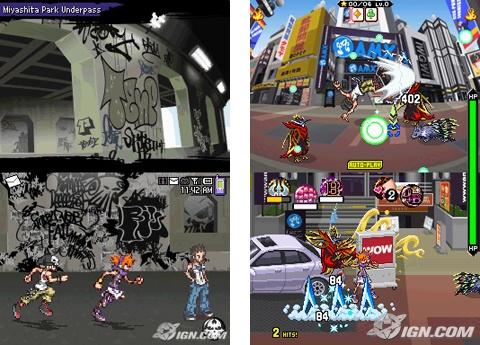
The World Ends with You is notable for its highly
innovative combat system, which requires players to control both the DS's screens at
the same time. In combat, the player's avatar, Neku, appears on the touch screen.
Over the course of the game, Neku collects objects called “pins”, most of which give
Neku magical abilities — called “psychs” — when equipped in combat. Each psych
is triggered by performing a specified action with the stylus (except for some which
are triggered by blowing into the DS's microphone). These actions include touching an
enemy, slashing an enemy (i.e. drawing a line across it), drawing a circle on the
screen, picking up and dragging onscreen objects, and rubbing the screen repeatedly.
Neku’s partner appears on the top screen, and the player uses either the D-pad or the
action buttons to choose the direction in which the partner attacks. Since the
buttons on the left-hand side of the DS have the same functions as the buttons on the
right-hand side, the player uses the non-dominant hand to push buttons while using
the dominant hand to control the touch screen. (Obviously, controlling two screens at
once takes some getting used to, but in practice the bottom screen usually requires
most of the player's attention.)
Controlling Neku involves the same physical motions as writing or drawing. To control
Neku, the player draws straight lines, circles and dots, or drags heavy objects over
enemies, as if using a pencil eraser. The game seems to ask the player to press
buttons and write or draw by hand at the same time, thus engaging simultaneously in
manual and digital means of writing. In short, then, playing TWEWY
feels like handwriting. Yet, for all the reasons cited above, it's not
handwriting; there is a profound gap between TWEWY
handwriting and originary handwriting. TWEWY only
detects whether the player has correctly executed the stylus action corresponding to
the pins Neku is wearing, and ignores the idiosyncratic aspects of the player's
handwriting. This becomes obvious, for example, when Neku wears two pins that require
similar stylus actions, such as “touch” and “tap rapidly.” The game has
trouble distinguishing between these actions because both are represented by the same
patterns of stroke data.
Where
TWEWY crucially differs from
Scribblenauts is that it acknowledges this gap between DS writing and
originary handwriting. It doesn't present the touchscreen as an uncritical
restoration of handwriting. It makes few explicit references to handwriting, except
that it uses the euphemism “erased” for “killed.” Its touchscreen commands
are not called penstrokes but “stylus actions.” The similarity between
handwriting and playing
TWEWY is not foregrounded.
TWEWY, then, is not constrained by the ideological
project of producing a replica of fantasized handwriting. Its success or failure as a
game is not measured by the similarity or dissimilarity of its writing system to the
fantasized version of handwriting. Instead of trying to literally recreate
handwriting, SquareEnix was able to simply seek to create a system that offers the
characteristic pleasure of handwriting: the expression of creative agency through
embodied interaction. Combat in
TWEWY is not
handwriting, but it's fun for the same reasons that handwriting is fun. It engages
the hand (both hands, in fact) and the rest of the body, whereas combat in other
SquareEnix titles is often a boring process of repetitive button-mashing. It allows
one to immediately view the results of one's actions, although these results come in
the form of damage to enemies rather than permanent inscriptions. Moreover,
TWEWY offers the player genuine freedom of play style, since
many different pins are available and the player can therefore choose the pins that
suit his/her personal play style. Unlike
Scribblenauts,
TWEWY doesn't claim that this freedom is unlimited or
that the player can “draw anything.” Rather than trying to uncritically satisfy
the desire for handwriting — a project which is impossible because this desire is
based on a constitutive lack —
TWEWY uses digital
processes to evoke the memory of handwriting. It is therefore able to open up a space
for critical reflection on what handwriting meant and on how our memory of
handwriting might inform our engagement with the post-digital world. This is in
keeping with Boym's definition of reflective as opposed to restorative nostalgia:
Restorative nostalgia puts emphasis on
nostos and proposes to rebuild the lost home and patch up the
memory gaps. Reflective nostalgia dwells in algia, in longing and
loss, the imperfect process of remembrance
[Boym 2002, 41]
. Rather than simply trying to revive handwriting (and inevitably failing),
TWEWY invites the player to notice the gaps between
its interface and handwriting, and to reflect on what these gaps might mean.
TWEWY further encourages such reflection by means of its
story, which, as with most SquareEnix games, is heavily foregrounded. The
TWEWY player uses the handwriting interface not only for its
own sake, but also as means of progressing through a story in which the values
associated with handwriting — creativity and individuality — play crucial roles. (By
contrast,
Scribblenauts effectively has no story; the
game never explains who Maxwell is, why he is able to write objects into existence,
or what his motivation is for collecting Starites.)
[16]
TWEWY’s story argues that creativity and idiosyncrasy
are of vital importance, but are not simply there for the taking; these values must
be obtained and defended through active effort. Moreover, these values are not
absolute. Taken to an extreme, the desire to assert and express the embodied self
leads merely to narcissism, to a neglect of the socially situated nature of the self.
In order to make productive use of the qualities that handwriting stands for, the
writer must realize that handwriting is useless in a vacuum; it only works because of
a constitutive gap between the self and the other. Handwriting requires a reader.
The game's setting — Shibuya, the fashion capital of Japan — is portrayed as a space
where many subcultures interact, each characterized by particular fashion and
lifestyle choices. Shibuya is a space where Neku and his allies are free to define
their own styles, to express their personalities visibly. Accordingly, creativity is
the guiding principle of the game's protagonists. Neku's role model is a graphic
designer named CAT, precisely because of CAT's philosophy of exuberant individuality
and freedom (CAT's motto is “Do what you want, how
you want, when you want it”). Neku's first partner, Shiki, is an aspiring
fashion designer.
Conversely, the goal of the game's villains is to eliminate creativity and
individuality, which they see as security risks. Mr. Kitaniji, one of the game’s
principal villains, calls Shibuya “a cacophony of
countless selfish wants” and claims, “As
that noise swells, it turns into crime, warfare... All the world’s ills can be
traced to individuality!” For example, in one episode the villains open a
new noodle restaurant and pay a popular blogger, the Prince, to recommend it to his
readers. The Prince's fans obediently flock to Shadow Ramen, not because they like
the food but because their arbiter of taste tells them to. As collateral damage,
Shadow Ramen threatens the existing local ramen restaurant, whose owner, Ken Doi, is
guided by his own honest creative compulsions. His motto is “I just serve up the kind of ramen I’d want to eat.” Faced with
the threat of bankruptcy, however, Ken Doi abandons this philosophy and starts
looking for the “next big thing” in ramen.
Thanks to Neku and his partner's intervention, however, the Prince becomes ashamed of
lying to his readers and of recommending food he dislikes. He retracts his positive
review of Shadow Ramen, saving Ken Doi's restaurant. A small battle in the war for
creativity has been won. Thus, at the same time that the game stresses the value of
creativity and individuality, it stresses that these values are constantly threatened
by conformity. Creativity exists in a constant dialectic with conformism — indeed,
perhaps it can't exist otherwise, since these concepts are defined by their mutual
opposition — and the preservation of creativity is therefore never an uncomplicated
task.
This is fortunate, because handwriting is a means of intersubjective communication as
well as creative expression. Rather than uncritically praising creativity as Scribblenauts does, TWEWY
suggests that when individuality is taken too far, it leads to solipsism. Creativity
and individuality function only within a larger value hierarchy which includes
respect for others. Neku's problem is that he focuses exclusively on self-expression,
and therefore has little concern for other people; hence the game's pessimistic
title. Over the course of the game he learns to collaborate productively with his
partners — something which the player is forced to also learn by mastering the game's
battle system, which requires simultaneous control of Neku and his partner — and in
the ending the title is replaced by the phrase “The
World Begins with You.”
TWEWY presents creativity not as an absolute value, but
as a function of the democratic interaction of multiple conflicting subjectivities.
The game demonstrates this perfectly with its mechanic of branding. The game includes
13 brands of clothing and pins, and each area in the game has a list of popular and
unpopular brands. Pins receive a power boost if they belong to a most popular brand,
and a penalty if they belong to an unpopular one. Thus, the player has an incentive
to be a slave to fashion. However, if the player fights several battles in an area
while wearing pins and clothing of a certain brand, then that brand will become more
popular and its corresponding pins will become more powerful. Thus the player also
has an incentive to be a trendsetter and is not discouraged from dressing the
characters according to his or her wishes; however, the player is also encouraged to
work at sharing his or her stylistic preferences with others. Much like handwriting,
fashion is of little use unless someone else can understand it.
Both these modes of expressing creativity are based on a constitutive gap between the
creative self and another self toward whom that creativity is expressed. The DS's
remediation of handwriting is necessarily incomplete, failing to permit the player to
perfectly express his or her self (because, for example, the DS's handwriting
interface works by stripping out the idiosyncratic qualities of the player's
handwriting). But this is only a literal example of the way in which handwriting
itself is also necessarily incomplete. As Derrida remarks, handwriting works not
because of the presence but because of the constitutive
absence of the
self; handwriting serves little purpose when the writer is actually present.
Signatures, for example, only work because they're iterable:
The condition of possibility for these
effects [of signature] is simultaneously, once again, the condition of their
impossibility, of the impossibility of their rigorous purity. In order to
function, that is, in order to be legible, a signature must have a repeatable,
iterable, imitable form; it must be able to detach itself from the present and
singular intention of its production.
[Derrida 1982, 328]
If DS handwriting “detaches itself”
from the embodied self that produces it, then it merely functions in the same way
that paper handwriting always has.
In encouraging the player to confront the incompleteness of handwriting, then, The World Ends with You opens up a space for critical
reflection on handwriting and on the concept of the self that handwriting
presupposes. It invites the player to ask whether handwriting ever really worked the
way it was supposed to, or whether the embodied self of handwriting ever existed to
begin with. The World Ends with You therefore goes
beyond Scribblenauts by using the unique properties of
the DS to present a reflective, critical version of the fantasy of handwriting.